
Every year, thousands of fires break out in UK properties — causing injuries, deaths, and devastating financial losses. As a landlord or property manager in England and Wales, a fire risk assessment is not optional: it is a legal requirement, and failing to carry one out can result in fines of up to £30,000, criminal prosecution, or even imprisonment for the most serious breaches.
This complete guide to fire risk assessment covers everything you need to know as a UK landlord: what the law requires, who is responsible, the full five-step process, the latest PAS 79 and BS 9792:2025 standards, a comprehensive checklist, typical costs across London and the wider UK, and how often your assessment must be reviewed. Whether you manage a single buy-to-let flat, a House in Multiple Occupation (HMO), or a commercial building, this guide gives you everything you need to stay fully compliant and keep your tenants safe.
What Is a Fire Risk Assessment?
A fire risk assessment is a structured, systematic examination of a building or premises designed to identify fire hazards, evaluate the risk they pose to the people who use the building, and determine what control measures are needed to protect life and property.
It is not a one-time tick-box exercise. Under UK law, a fire risk assessment is a living document that must be reviewed regularly and updated whenever significant changes occur in the building or its occupancy.
What Does a Fire Risk Assessment Examine?
A thorough assessment covers every aspect of fire safety in a building, including:
- Ignition sources — faulty wiring, overloaded sockets, open flames, cooking appliances, portable heaters, smoking materials
- Fuel sources — combustible materials, flammable liquids, rubbish build-up, soft furnishings, refuse storage areas
- Oxygen sources — ventilation systems, air conditioning, storage of oxidising materials
- People at risk — residents, staff, visitors, and especially vulnerable individuals such as elderly tenants, children, or those with mobility, sensory, or cognitive impairments
- Escape routes — whether corridors, stairwells, and exits are clear, signed, and adequately lit
- Detection and warning systems — smoke alarms, heat detectors, fire alarm panels
- Firefighting equipment — fire extinguishers, fire blankets, sprinkler systems
- Fire doors — whether they are properly rated, fitted, and self-closing
- Emergency lighting — whether it functions when main power fails
- Management arrangements — fire drills, staff training, written emergency plans
Is a Fire Risk Assessment a Legal Requirement in the UK?
Yes — without exception for rented properties. The legal duty applies to virtually every type of premises in England and Wales where people other than the owner-occupier are present. If you rent your property to any tenant, or if any part of your building is used commercially, you are legally required to carry out a fire risk assessment.

The Regulatory Reform (Fire Safety) Order 2005
The Regulatory Reform (Fire Safety) Order 2005 (RRO) is the primary legislation governing fire safety in non-domestic premises in England and Wales. In force since 1 October 2006, it consolidated over 70 older fire safety laws into a single, coherent framework — placing clear, enforceable duties on the “responsible person”.
| Article | Key Requirement |
|---|---|
| Article 9 | Carry out a suitable and sufficient fire risk assessment. Record findings in writing if you employ 5 or more people. |
| Article 11 | Implement and maintain fire precautions: detection systems, alarms, escape routes, firefighting equipment, and emergency procedures. |
| Article 13 | Ensure emergency routes and exits are always clear, adequately signed, and lit. |
| Article 17 | Maintain and regularly test all fire safety systems and equipment, keeping written records. |
| Articles 21–22 | Provide fire safety training and information to all relevant persons in the building. |
Who Is the “Responsible Person”?
Under the RRO, the responsible person is:
- The employer, where the premises are used as a workplace
- The owner or landlord, where the premises are not a workplace
- The freeholder or managing agent, for common areas of HMOs and blocks of flats
- The occupier, where the building is occupied under a lease or licence and is not a workplace
Where multiple responsible persons share a building (for example, a mixed-use block), they must cooperate and coordinate their fire safety arrangements under Articles 7 and 19 of the RRO.
The Building Safety Act 2022
The Building Safety Act 2022 significantly strengthened fire safety obligations, particularly for higher-risk residential buildings — defined as those 18 metres or more in height (or 7 or more storeys) containing at least two residential units.
Key requirements include:
- Mandatory written fire risk assessments for all regulated buildings, regardless of employee count
- Named assessors — the identity of whoever carries out the assessment must be formally recorded
- Information sharing with residents — responsible persons must keep occupants informed of fire risks and safety measures
- Record transfer on change of ownership — all fire safety documentation must be passed to the new responsible person
The Fire Safety (England) Regulations 2022
In force from 23 January 2023, these Regulations impose additional obligations on responsible persons in multi-occupied residential buildings:
- Quarterly checks of all fire doors in communal areas (self-closers, seals, frames, hinges)
- Annual checks of all flat entrance doors (to the extent reasonably practicable)
- In buildings over 11 metres: monthly checks of lifts and key firefighting equipment
- Annual fire safety instructions to all residents
- Information about the building’s evacuation strategy and external wall systems provided to residents
Who Can Carry Out a Fire Risk Assessment?
The assessment must be carried out by a competent person — someone with sufficient training, experience, knowledge, and skills to identify hazards and evaluate risks reliably. For simple, low-risk single-let properties, an informed landlord may qualify. For HMOs, blocks of flats, commercial premises, or buildings with vulnerable occupants, a professional fire risk assessor is strongly recommended — and often required by licensing conditions.
When selecting a professional assessor, look for:
- Membership of a recognised professional body — the Institution of Fire Engineers (IFE) or the Fire Risk Assessment Competency Council (FRACC)
- BAFE SP205 certification — the UK’s leading third-party accreditation scheme for fire risk assessors
- Familiarity with PAS 79 and BS 9792:2025 (see below)
- Adequate professional indemnity insurance
- Specific experience with your building type
The 5 Steps of a Fire Risk Assessment
The UK government and all fire authorities describe fire risk assessment as a five-step process. Each step builds on the last to produce a complete, legally compliant picture of fire risk in your property.
Step 1 — Identify Fire Hazards
Walk the entire property systematically and identify:
- Sources of ignition: faulty wiring, overloaded sockets, portable heaters, cooking appliances, smoking areas, arson-risk zones
- Sources of fuel: paper, cardboard, soft furnishings, flammable liquids, refuse accumulation, combustible wall coverings
- Sources of oxygen: ventilation shafts, air conditioning, open windows near fuel sources, oxidising chemicals in storage
The goal is to identify not just what is present, but which realistic combination of these three elements could cause a fire to start and spread quickly.
Step 2 — Identify People at Risk
Consider everyone who might be in the building or affected by a fire:
- Permanent residents and their household members
- Staff, contractors, and maintenance workers
- Visitors, delivery personnel, and members of the public
- Vulnerable individuals — elderly residents, young children, people with mobility impairments, hearing or sight loss, or cognitive difficulties. Under BS 9792:2025, these individuals require a Person-Centred Fire Risk Assessment (PCFRA) using the Annex E template.
- Occupants in adjacent properties who might be affected by fire spread
Step 3 — Evaluate Risks and Implement Control Measures
For each hazard identified, assess the likelihood of a fire starting, how quickly it could spread, and whether existing controls are adequate. Typical control measures include:
- Removing or reducing ignition and fuel sources at source
- Installing or upgrading smoke and heat detection
- Ensuring fire doors are correctly rated, fitted, and maintained
- Keeping all escape routes permanently clear of obstructions
- Installing emergency lighting on every escape route
- Preparing a written fire emergency plan and evacuation procedure
Step 4 — Record Your Findings and Prepare an Action Plan
The RRO requires a written record if you employ five or more people. However, best practice — strongly recommended for all landlords regardless of size — is to keep a written record of:
- Every hazard identified and its assessed risk level
- The persons at risk
- Control measures already in place
- Actions required to remedy deficiencies, who is responsible, and a target completion date (prioritised as immediate, short-term, or medium-term)
- The name, qualifications, and organisation of whoever carried out the assessment
Your written report should follow the standardised format set out in PAS 79 or BS 9792:2025 (Annex A). A consistent format makes the assessment easier to audit, share, and update.
Step 5 — Review and Update Regularly
A fire risk assessment must be reviewed:
- At least annually for most properties
- After any significant change to the building’s structure, layout, or use
- After any change in occupants — particularly where vulnerability levels change
- Following a fire, near-miss, or fire alarm activation
- Whenever there is reason to believe the existing assessment is no longer valid
Fire Risk Assessment Standards: PAS 79 and BS 9792:2025
Two key British Standards define how fire risk assessments should be conducted and documented in the UK. Understanding them helps you know what to expect from a professional assessor — and how to verify they are working to the right standard.
PAS 79 — The Established Practical Framework
PAS 79 (Publicly Available Specification 79) was developed by the British Standards Institution (BSI) as a practical guidance framework for fire risk assessors. Although not itself a legal requirement, PAS 79 is widely regarded as the industry benchmark for fire risk assessment methodology and report format in England and Wales.
PAS 79-1:2020 applies to non-domestic premises; PAS 79-2:2020 applied to residential buildings and HMOs — though the latter has now been superseded by BS 9792:2025 (see below).
What PAS 79 requires of assessors:
- A structured, methodical approach to hazard identification and risk evaluation
- Clear documentation using a standardised report format
- Prioritised action plans with defined timescales
- Defined FRA types (Types 1–4) based on the inspection depth required
- Formal declarations of assessor competence
BS 9792:2025 — The New Residential Standard
Published by BSI on 31 August 2025, BS 9792:2025 is now the formal British Standard Code of Practice for fire risk assessments in housing. It replaces PAS 79-2:2020 and represents a significant upgrade in rigour and consistency for residential assessments.
Buildings covered by BS 9792:2025:
- Houses in Multiple Occupation (HMOs)
- Purpose-built blocks of flats and apartment buildings
- Converted buildings containing flats
- Sheltered housing and supported living accommodation
- Student accommodation
- Shared communal areas in any multi-occupancy residential building
Not covered: single private dwellings, short-term holiday lets, care homes, or commercial/industrial premises.
| Key Feature | What It Means for Landlords |
|---|---|
| Four defined FRA Types (1–4) | Type 1 (common areas, non-intrusive) is the baseline for most blocks. Type 4 (full intrusive inspection including within dwellings) is required for older, higher-risk, or post-cladding-remediation buildings. |
| Person-Centred FRAs (PCFRAs) | Assessments must now evaluate individual occupant characteristics — mobility, sensory, cognitive, and health factors — using Annex E template for vulnerable residents. |
| Standardised reporting via Annex A | All assessors must use the Annex A format, making reports consistent and auditable across different buildings and assessors. |
| Formal British Standard status | Replaces a PAS (guidance only) with a full Code of Practice, giving it stronger legal and professional weight in enforcement proceedings. |
| Alignment with post-Grenfell legislation | Fully consistent with the Fire Safety Act 2021 and Fire Safety (England) Regulations 2022. |
Types of Fire Risk Assessment: Residential, HMO, and Commercial
The approach taken varies significantly by property type. Here is what landlords and property managers need to know about each category.
HMO Properties
Houses in Multiple Occupation carry the highest fire risk of any residential property type. Multiple unrelated occupants, shared kitchens, and higher occupancy density significantly increase both the likelihood and potential severity of a fire. HMO landlords must comply with both the RRO 2005 and HMO licensing conditions, which typically require:
- Interlinked smoke alarms in every bedroom and common area
- Heat detectors in all kitchens
- FD30S-rated, self-closing fire doors on all habitable rooms
- Emergency lighting on all escape routes
- Fire blankets in kitchens
- At least one appropriate fire extinguisher per floor
- Clearly displayed fire action notices at every call point
- Written fire risk assessment reviewed at least annually
Blocks of Flats and Apartment Buildings
The Fire Safety Act 2021 and the Fire Safety (England) Regulations 2022 significantly increased obligations for responsible persons managing blocks of flats. A fire risk assessment for a block of flats must cover:
- All common areas — corridors, stairwells, lobbies, plant rooms, car parks
- The structure and external walls, including any cladding systems (following the Grenfell Tower Inquiry findings)
- All flat entrance doors — whether they meet current fire door standards
- The building’s evacuation strategy — whether “stay put” or simultaneous evacuation applies, and whether this has been formally assessed against current risk
Single-Let Residential Properties
For a straightforward single-let property, a fire risk assessment focuses on:
- Working smoke alarms on each storey (required under the Smoke and Carbon Monoxide Alarm (Amendment) Regulations 2022)
- Carbon monoxide detectors in all rooms with a solid fuel burning appliance
- Clear escape routes from all habitable rooms
- Safe storage of flammable materials
- Electrical installation safety — this links directly to your EICR obligations
- Gas appliances and pipework — linking to your annual CP12 Gas Safety Certificate requirement
Commercial Properties
Commercial fire risk assessments are governed primarily by the RRO 2005 and focus on workplace safety obligations. Key requirements include:
- Fire extinguishers appropriate to the class of fire risk (Class A, B, C, D, or F) in the correct quantity and distribution
- Fire detection and alarm systems calibrated to the size, layout, and occupancy of the premises
- Documented fire safety training for all staff and regular fire evacuation drills
- Written emergency evacuation plans with clearly identified assembly points
- Regular maintenance records for all fire safety equipment
Fire Risk Assessment Checklist: What Every Assessment Should Cover
Whether you are commissioning a professional assessment or preparing your property beforehand, the following checklist covers the key areas that any competent assessor will examine in detail.
Smoke and Heat Detection
- Smoke alarm on every floor and in every bedroom (Grade D, LD2 minimum for HMOs)
- Heat detector in kitchen areas
- All alarms tested regularly — records kept
- Interlinked alarms in HMOs and blocks of flats
- Central fire alarm panel (where applicable) tested weekly and serviced annually
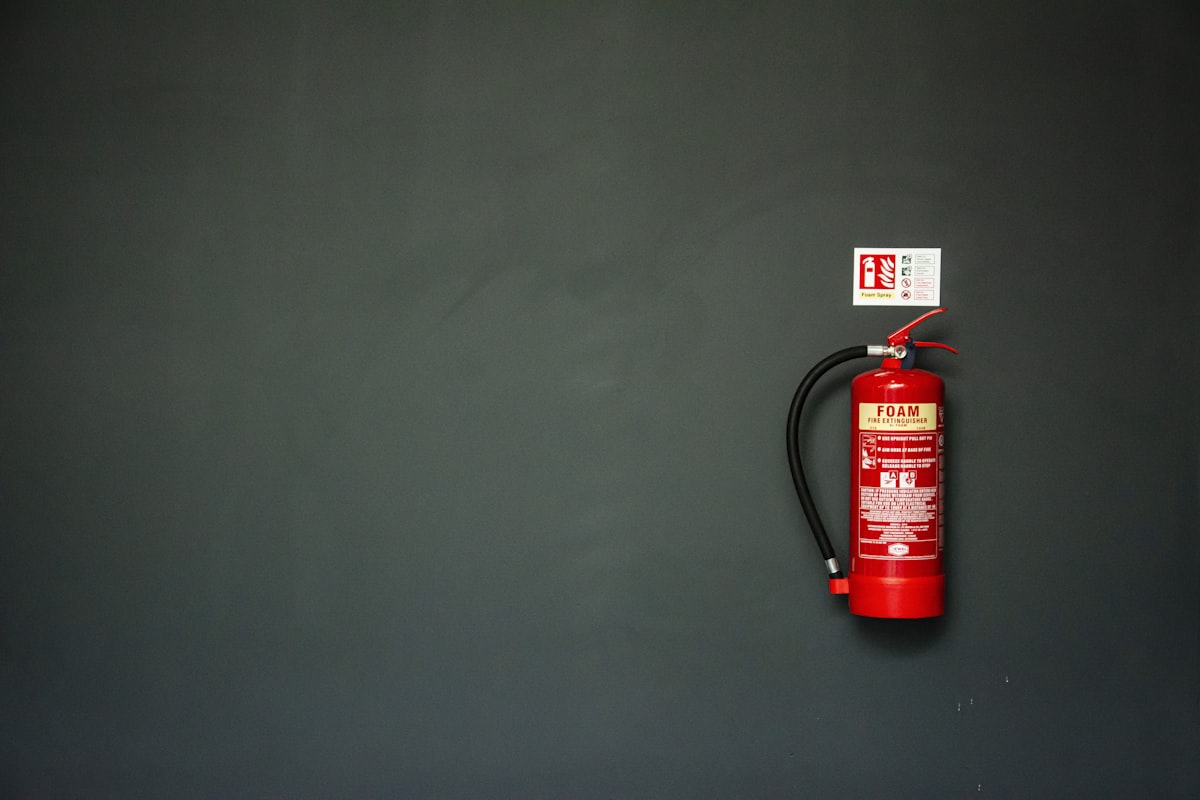
Fire Extinguishers
- Correct type for the class of fire risk present (water, foam, CO2, powder, wet chemical)
- Mounted at the correct height and clearly visible
- Within service date — annual inspection by a competent person
- Correct number and distribution for the premises size and risk profile
Fire Doors
- All fire doors correctly rated (FD30 or FD60 as required by the building’s risk profile)
- Self-closing devices fitted and functioning correctly
- No gaps greater than 3mm around the frame when closed
- Intumescent seals and smoke seals intact with no damage
- Doors never wedged open — any hold-open devices must be fire-alarm-activated
- Inspection label present and within date
- Quarterly inspection records maintained (required under Fire Safety (England) Regulations 2022 for multi-occupancy residential buildings)
Emergency Lighting
- Emergency lighting covers all escape routes, stairwells, and final exit doors
- Exit signs illuminated and clearly visible from both directions of travel
- Monthly function test carried out and recorded
- Annual three-hour duration test carried out and recorded
- System compliant with BS 5266-1
Escape Routes
- All corridors, stairwells, and exits permanently clear of all obstructions
- Exit routes clearly signed with photoluminescent or illuminated signage
- Final exit doors openable from the inside without a key at all times
- No combustible materials stored on escape routes
- Escape route travel distances comply with Approved Document B
Documentation and Management
- Fire action notices displayed at every call point
- Evacuation assembly point clearly identified and communicated to all occupants
- Written fire emergency plan in place and up to date
- Fire risk assessment reviewed within the past 12 months
- All maintenance records, drill logs, and training records retained for a minimum of three years
How Much Does a Fire Risk Assessment Cost in London and the UK?
Fire risk assessment costs vary based on property size, complexity, building type, and the assessor’s location and experience. London assessors typically charge a premium of 15–25% above the national average, reflecting higher operating costs in the capital. The table below gives a realistic guide to current market rates.
| Property Type | Size | Outside London | Greater London |
|---|---|---|---|
| Single-let flat or studio | Up to 50 m² | £150 – £250 | £180 – £350 |
| Single-let house (1–3 bed) | 50–120 m² | £200 – £350 | £250 – £450 |
| Small HMO (3–5 occupants) | 80–150 m² | £300 – £550 | £350 – £700 |
| Large HMO / block up to 10 units | 150–500 m² | £550 – £1,000 | £700 – £1,300 |
| Small commercial or retail premises | Up to 200 m² | £200 – £450 | £250 – £600 |
| Medium commercial premises | 200–500 m² | £400 – £800 | £500 – £1,000 |
| Large commercial or industrial | 500–2,000 m² | £800 – £2,000 | £1,000 – £2,500 |
| Hotel, care home, or high-risk building | 500 m²+ | £1,500 – £3,500 | £2,000 – £5,000 |
Factors that increase the cost of your assessment:
- Number of storeys and complexity of the building layout
- High number of fire doors and safety systems requiring individual inspection
- Intrusive inspection required (Type 2, 3, or 4 under BS 9792:2025)
- Preparation of a detailed written report compliant with PAS 79 or BS 9792:2025 Annex A
- Travel and access requirements for properties outside central London
Professional Assessment vs DIY: What You Need to Know
Legally, a landlord can carry out their own fire risk assessment provided they are competent to do so. In practice, however, a DIY assessment for anything other than a simple single-let property carries significant legal and financial risk:
- Without formal training, hidden hazards — inadequate compartmentation, incorrect fire door ratings, concealed wiring faults — are easily missed
- A professional report provides legal protection: if a fire occurs and you cannot demonstrate a proper assessment was in place, you face personal liability
- Your buildings insurer may refuse to pay out if a professional assessment was not conducted
- Local authorities and fire services expect professional-standard reports for HMOs, multi-occupancy buildings, and commercial premises
- If tenants or residents are harmed in a fire, inadequate fire risk assessment is a central element of any subsequent prosecution
Penalties for Non-Compliance: What Is at Stake
Failing to meet your fire risk assessment obligations is not a low-risk gamble. UK courts and fire authorities treat breaches seriously, and the penalties reflect the life-safety nature of these requirements.
- Enforcement notices — the local fire and rescue authority can require you to implement specific remediation measures within a defined timescale
- Prohibition notices — if a property is deemed an immediate fire danger, the fire authority can prohibit its use until deficiencies are resolved, resulting in immediate loss of rental income
- Unlimited fines — Crown Courts can impose unlimited financial penalties for serious breaches of the RRO
- Up to two years’ imprisonment — for the most serious offences, including deliberate disregard of fire safety duties where lives are put at risk
- Section 21 notices invalidated — you cannot legally serve a Section 21 eviction notice if you have not met your fire safety obligations, preventing you from regaining possession of your property
- Insurance may be voided — if a fire occurs and a proper assessment was not in place, your buildings insurer may decline to pay out on the claim
Real UK enforcement cases illustrate the scale of these consequences. In the Crownpark Investments case, a London landlord and managing company were fined £250,000 plus £49,500 in costs after a fire in a converted London flat revealed missing fire risk assessments, inadequate fire doors, and no working fire detection. In the Hillcroft Care Home case in South Wales, a court imposed fines totalling £432,944 after inspectors found blocked escape routes, missing alarms, and faulty fire doors.
How Often Should a Fire Risk Assessment Be Reviewed?
The RRO requires fire risk assessments to be reviewed regularly and whenever there is reason to believe they may no longer be valid. The standard industry guidance by property type is:
| Property Type | Recommended Review Frequency |
|---|---|
| Single-let residential flat or house | Every 1–2 years, or on change of tenancy |
| HMO | Annually, or whenever occupancy or layout changes |
| Block of flats (under 11 metres) | Annually |
| Block of flats (11 metres or above) | Annually, plus additional periodic checks under the Fire Safety (England) Regulations 2022 |
| Commercial premises (lower risk) | Every 1–3 years depending on assessed risk level |
| Commercial premises (higher risk) | Annually or more frequently |
An immediate review is also required after: any structural alteration to the building; a change in the number or vulnerability of occupants; any fire alarm activation or fire incident; changes to how the building is used; or the introduction of new hazards.
Fire Risk Assessment for London Landlords: Local Considerations
London presents specific fire safety challenges that landlords and property managers should be aware of. The capital has the highest concentration of HMOs, converted Victorian and Edwardian properties, high-rise residential blocks, and mixed-use buildings of any region in the UK — all of which carry elevated fire risk and attract the closest regulatory scrutiny.
- London Fire Brigade (LFB) carries out more enforcement visits than any other fire authority in England
- HMO licensing conditions across London boroughs routinely specify fire safety requirements that go beyond the statutory minimum
- Post-Grenfell, responsible persons for buildings over 11 metres in London face the highest level of regulatory oversight in the country
- Cladding remediation works in many London high-rises have triggered mandatory re-assessment under the Building Safety Act 2022
If you manage properties in London, working with an assessor who has specific experience in London borough HMO licensing conditions and LFB enforcement expectations is strongly advisable.
Frequently Asked Questions
Can a landlord carry out their own fire risk assessment?
Yes, provided they are genuinely competent to do so. For a simple, low-risk single-let property, a landlord who has studied the relevant government guidance may manage an adequate assessment. For HMOs, blocks of flats, or any complex property, a professional assessor is strongly recommended — and in most HMO licensing conditions, required.
How long does a fire risk assessment take?
A small single-let flat may take 45–90 minutes on site. A large HMO or commercial building can take half a day or more. Expect additional time for the written report — a quality PAS 79 or BS 9792:2025-compliant report typically takes several additional hours to prepare after the inspection visit.
What is the difference between a Type 1 and Type 4 fire risk assessment?
Under BS 9792:2025: Type 1 is a non-intrusive inspection of common areas only — the baseline for most blocks of flats. Type 4 is a full intrusive inspection of both common areas and a sample of individual dwellings, required for older buildings, buildings with a history of fire safety failures, or where there is genuine uncertainty about internal compartmentation and construction.
Are digital fire risk assessments legally accepted in the UK?
Yes. Digital FRAs are fully recognised in the UK provided they contain all the information required by the RRO and follow the relevant PAS 79 or BS 9792:2025 format. Many professional assessors now use tablet-based software to complete assessments on site and generate a digital report in real time.
What happens if I fail to carry out a fire risk assessment?
You are in breach of the Regulatory Reform (Fire Safety) Order 2005. The local fire and rescue authority can serve enforcement notices, issue prohibition notices preventing use of the property, and prosecute you. Penalties include unlimited fines and up to two years’ imprisonment for the most serious breaches.
Do tenants have the right to see my fire risk assessment?
Yes. Under the Building Safety Act 2022 and the Fire Safety (England) Regulations 2022, residents in multi-occupancy buildings have the right to receive fire safety information and may request to see the fire risk assessment record. Responsible persons must proactively share fire safety instructions with residents at least annually.
Does a fire risk assessment cover my EICR, gas safety, or EPC obligations?
No — a fire risk assessment covers fire safety only. Your legal obligations as a landlord also include an annual Gas Safety Certificate (CP12), an Electrical Installation Condition Report (EICR) every five years, and a valid Energy Performance Certificate (EPC) with a minimum Band E rating for let properties. However, a fire risk assessment will flag concerns about electrical or gas hazards insofar as they represent ignition risks.
Can I bundle my fire risk assessment with other compliance certificates?
Yes — and bundling is strongly recommended to save time and reduce disruption to tenants. Many compliance providers offer combined visit packages where your fire risk assessment, EICR, Gas Safety Certificate, and EPC can all be completed in a single engineer visit. This is particularly cost-effective for HMO landlords and portfolio managers.
Book Your Fire Risk Assessment With Landlord Compliance Certificate
Landlord Compliance Certificate provides professional fire risk assessments for residential and commercial properties across London and the wider UK. Our fully qualified assessors work to PAS 79 and BS 9792:2025 standards and deliver clear, actionable written reports within 24–48 hours.
We can also bundle your fire risk assessment with your EICR, Gas Safety Certificate (CP12), and EPC — minimising disruption and reducing overall cost through our multi-service visit packages.
- Transparent, upfront pricing — no hidden fees
- Digital certificates and reports delivered within 24–48 hours
- Fully accredited, insured, and vetted engineers
- Bundle discounts for multiple services in one visit
- Serving landlords across London and the wider UK
Call us on 020 3856 8943, WhatsApp us on +44 20 8145 5369, or email info@landlordcompliancecertificate.co.uk to book your assessment today.