
London is the UK’s most densely rented city. Millions of people live in private rented accommodation across the capital’s 33 boroughs — in Victorian terraces converted to flats, purpose-built tower blocks, HMOs, mixed-use buildings, and everything in between. Every one of those properties comes with fire safety obligations, and London Fire Brigade (LFB) is the most active enforcement authority in the country.
If you are a landlord, freeholder, managing agent, or property manager in London, a fire risk assessment is not optional. It is a legal requirement under the Regulatory Reform (Fire Safety) Order 2005 — and the rules have been significantly tightened since then by the Fire Safety Act 2021, the Fire Safety (England) Regulations 2022, and Section 156 of the Building Safety Act 2022. Not keeping up is expensive: LFB issued hundreds of enforcement notices and prohibition orders across London in 2023 alone.
This guide cuts through the complexity. We explain exactly what fire risk assessment requirements apply to each property type in London, who is legally responsible, what equipment and systems must be in place, how often your assessment needs reviewing, and what happens if you do not comply.
London Fire Safety Facts
London landlords face unlimited fines and up to two years in prison for failing to meet fire risk assessment requirements.
£80,170
Fine issued to a London property manager in 2021 for missing fire risk assessments in a North London block of flats
33
London boroughs actively monitored by LFB enforcement teams — every one with its own HMO licensing conditions
Oct 2023
Date Section 156 of the Building Safety Act 2022 came into force, requiring all responsible persons to record FRA findings in writing
Does Your London Property Need a Fire Risk Assessment?
Almost certainly, yes. The Regulatory Reform (Fire Safety) Order 2005 applies to virtually every type of premises in England and Wales except a single private dwelling occupied solely by the owner. In practice, this means:
Single-let residential flats and houses — the common areas and shared access must be assessed. From 1 October 2023, all findings must be recorded in writing regardless of how many employees you have.
Houses in Multiple Occupation (HMOs) — all shared areas, hallways, kitchens, and individual bedrooms must be assessed. HMO licensing in London boroughs typically goes beyond the statutory minimum.
Blocks of flats and apartment buildings — all common areas, external walls, structural elements, and flat entrance doors must be assessed. Post-2022, evacuation strategy must also be documented.
Commercial properties, offices, and retail premises — all areas accessible to employees, customers, or visitors require a comprehensive workplace fire risk assessment.
Mixed-use buildings — where residential flats sit above a commercial unit, both the residential common areas and the commercial premises require their own assessments, and the responsible persons must cooperate.

The Legal Framework: Four Laws Every London Landlord Must Know
Fire safety law in England has been reshaped significantly since the Grenfell Tower fire in 2017. Four pieces of legislation now work together to define a landlord’s obligations. Here is what each one requires of you.
Regulatory Reform (Fire Safety) Order 2005 (RRO)
The RRO is the foundation of UK fire safety law. It places a legal duty on the “responsible person” to carry out a suitable and sufficient fire risk assessment, implement control measures, maintain fire safety systems, and review the assessment regularly. It applies across England and Wales to all non-domestic premises and to common areas of residential buildings.
England & Wales
All non-domestic premises
Fire Safety Act 2021
The Fire Safety Act clarified and extended the scope of the RRO. It confirmed that fire risk assessments for buildings containing two or more domestic dwellings must now explicitly cover: the building’s external walls and cladding, all flat entrance doors (not just communal fire doors), and balconies and anything attached to the external walls. This was a direct legislative response to Grenfell.
Multi-occupancy residential
Cladding & flat doors now in scope
Fire Safety (England) Regulations 2022
These Regulations (in force 23 January 2023) add specific operational duties for responsible persons in multi-occupied residential buildings. Quarterly fire door checks in communal areas, annual checks of flat entrance doors, monthly checks of lifts and key equipment in buildings over 11 metres, and the provision of annual fire safety instructions to residents are all now mandatory.
Multi-residential buildings
Quarterly fire door checks
Building Safety Act 2022 — Section 156 (from October 2023)
Section 156 of the Building Safety Act amended the RRO to require all responsible persons to record their fire risk assessment findings in writing — regardless of property size or employee count. Previously, only employers with five or more staff had to record. Now, every landlord must keep a written record. The Act also requires you to record the identity of whoever carried out the assessment, maintain a UK contact address, and share fire safety information with co-responsible persons and residents.
ALL landlords must record findings
Higher-risk building rules
Section 21 Notices & Insurance
If your fire safety obligations are not met, you cannot legally serve a valid Section 21 eviction notice to regain possession of your property. Additionally, if a fire occurs in a property where a proper fire risk assessment was not in place, your buildings insurer may decline the claim entirely. Both risks are entirely avoidable.

Who Is the Responsible Person for Fire Safety in London?
Under the RRO 2005, the “responsible person” is the individual or organisation who has legal control over the premises and bears the duty to carry out and maintain the fire risk assessment. Getting this right matters — if enforcement action is taken, it is the responsible person who faces prosecution.
Private Landlord (Single Let)
You are the responsible person for all common areas, shared access points, and structural elements of your property. Inside a self-contained flat, the tenant is responsible for their own dwelling — but you remain responsible for the hallway, staircase, and entrance.
HMO Landlord
You are responsible for all shared spaces and all individual rooms occupied by tenants, since these are not self-contained dwellings. Your HMO licence will almost certainly specify minimum fire safety standards that must be maintained throughout.
Freeholder / Managing Agent
For a block of flats, the freeholder or the managing agent they appoint is the responsible person for all common areas. This includes corridors, stairwells, lobbies, roof spaces, plant rooms, bin stores, and all flat entrance doors. They must also cover external walls and cladding.
Multiple Responsible Persons
In mixed-use buildings or large blocks with multiple landlords, all responsible persons must cooperate, share fire safety information, and coordinate their assessments. Since October 2023, each must also share a UK contact address with the others and with residents.
Fire Risk Assessment Requirements by Property Type in London
Different property types carry different fire risks — and different legal obligations. Here is a clear breakdown of what is required for each type of property a London landlord is likely to manage.
Single-Let Residential Properties
A self-contained flat or house let to a single household. The RRO applies to common areas; within the flat itself, specific housing law applies.
- Working smoke alarms on every floor (mandatory under the Smoke and Carbon Monoxide Alarm (Amendment) Regulations 2022)
- Carbon monoxide detector in every room with a solid fuel burning appliance
- Clear and unobstructed means of escape from all habitable rooms
- Electrical installation in safe condition — linked to your EICR duties (see our Residential EICR service)
- Gas appliances safe and annually certified — linked to your Gas Safety Certificate (CP12) obligation
- Written fire risk assessment record kept on file (required since October 2023 under Section 156)
Houses in Multiple Occupation (HMOs)
Highest Risk
HMOs — three or more unrelated people sharing a kitchen, bathroom, or toilet — carry the highest residential fire risk and attract the strictest regulation. London boroughs universally impose additional licensing conditions beyond the statutory minimum.
- Grade D, LD2 interlinked smoke alarm system — in every bedroom and all common areas
- Heat detector in every kitchen
- FD30S self-closing fire doors on all habitable rooms (30-minute fire resistance, smoke-sealed)
- Emergency lighting on all escape routes, stairwells, and corridors
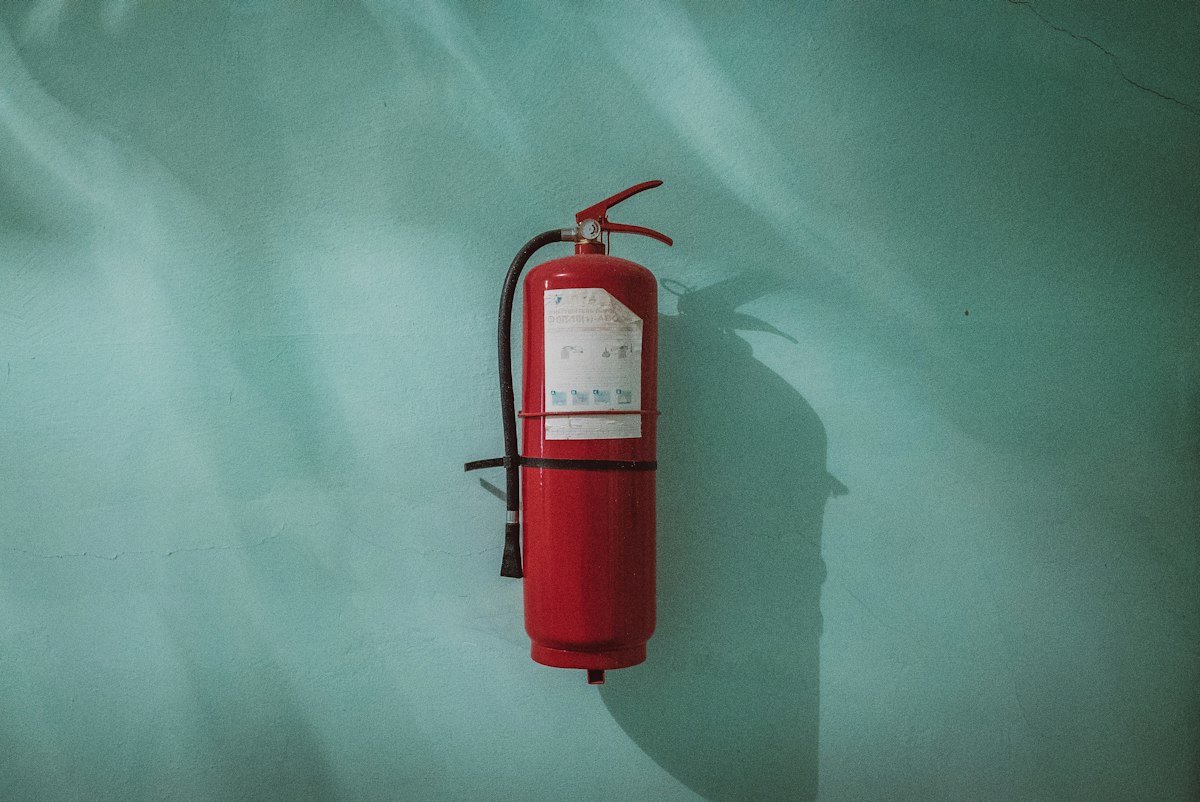
- At least one appropriate fire extinguisher per floor and a fire blanket in each kitchen
- Fire action notices displayed at every alarm call point
- Written fire risk assessment reviewed at least annually — and whenever tenants change or layout alters
- Compliance with your specific London borough HMO licence conditions (these often exceed the national standard)
Blocks of Flats & Apartment Buildings
Requirements for blocks of flats in London are now tiered by building height — a direct result of the post-Grenfell legislative programme. The taller the building, the more extensive and frequent the obligations.
A Under 11 metres (approx. 3 storeys)
- Full fire risk assessment of all common areas (corridors, stairwells, lobbies, bin stores)
- Annual review as a minimum; assessment to cover flat entrance doors and external walls
- Annual fire safety instructions provided to all residents
B 11 metres to 18 metres (approx. 4–6 storeys)
- Everything in Category A, plus:
- Monthly checks of all lifts and key firefighting equipment
- Quarterly checks of all fire doors in communal areas (self-closers, seals, frames)
- Annual checks of all flat entrance doors
- Building evacuation strategy formally documented and shared with residents
C 18 metres or 7+ storeys — Higher-Risk Buildings (HRBs)
- Everything in Categories A and B, plus:
- Building must be registered with the Building Safety Regulator (BSR)
- A Safety Case Report must be produced and kept up to date (“Golden Thread” of building safety information)
- Principal Accountable Person must be clearly identified and registered
- External wall system (EWS) must be assessed — cladding remediation may be required
- BSR is now the new building control authority — routine LFB inspections expected
Commercial Properties & Workplaces
Commercial premises in London are regulated by the RRO 2005, with the employer or building operator as the responsible person. The assessment must cover all areas accessible to employees, customers, contractors, and visitors.
- Comprehensive fire risk assessment covering all areas of the premises, conducted by a competent person
- Fire extinguishers of the correct class (A, B, C, D, or F) for the identified fire risks, correctly located and serviced annually (see our Fire Extinguisher Servicing)
- Fire detection and alarm system appropriate to the size and use of the premises (see our Fire Alarm Installation)
- Emergency lighting on all escape routes and at final exit points (see our Emergency Lighting Testing)
- Documented staff fire safety training and regular evacuation drills
- Written fire emergency plan with clearly identified assembly points
- All maintenance records kept for a minimum of three years

Key Equipment Requirements: Fire Doors, Alarms, Emergency Lighting & Extinguishers
Beyond the assessment document itself, London landlords must ensure specific fire safety equipment is installed, tested, and maintained. Here is what the law requires for each type.
Fire Doors
- FD30 minimum in most residential settings; FD60 in higher-risk areas
- Self-closing devices fitted and functional — never propped open
- Gap no greater than 3mm around frame when closed
- Intumescent and smoke seals intact
- Quarterly inspection records required (blocks of flats)
Fire Alarms & Smoke Detectors
- Smoke alarm on every floor of any rented property (legal minimum)
- Interlinked alarms in all HMOs and communal areas of blocks
- Heat detector in all kitchens (not a smoke alarm — it will trigger on cooking)
- Alarm panel tested weekly and serviced annually where applicable
- Test records kept on site and available to inspectors
Emergency Lighting
- Required on all escape routes, stairwells, and at final exit doors
- Must operate on battery backup for a minimum of 3 hours
- Monthly function test and annual 3-hour drain test required
- Exit signs illuminated and visible from both directions of travel
- Must comply with BS 5266-1
Fire Extinguishers
- Required where a fire risk assessment identifies a need (all HMOs, commercial premises)
- Must be the correct class for the fire risks present in each area
- Annual service by a competent person — records kept for 3 years
- Mounted at the correct height, clearly visible, and unobstructed
- Not required inside individual private self-contained flats
Why London Has Stricter Expectations Than the Rest of England
While the laws are the same across England, London’s unique property landscape and the active enforcement stance of London Fire Brigade mean that landlords in the capital face more scrutiny than almost anywhere else in the country.
London Fire Brigade Enforcement
LFB is the statutory fire authority for all 33 London boroughs. It carries out proactive inspection programmes targeting high-risk property types, including HMOs, converted Victorian terraces, purpose-built residential blocks, and mixed-use buildings. If LFB serves you an enforcement notice, you typically have a short window to comply — and failure to do so can result in a prohibition notice shutting the property down until deficiencies are resolved.
Borough HMO Licensing
Every London borough sets its own HMO licensing conditions. Many go well beyond the national minimum — specifying fire door grades, alarm grades, and inspection frequencies that are stricter than the statutory floor. Check your specific borough’s requirements.
Cladding & External Walls
Post-Grenfell, any building in London with potentially unsafe cladding must have its external wall system (EWS) formally assessed. This has direct implications for the fire risk assessment scope for blocks of flats built or refurbished between approximately 1980 and 2020.
PAS 79 & BS 9792:2025
LFB and local authority inspectors increasingly expect assessments to follow recognised standards. PAS 79-1 (non-domestic) and the new BS 9792:2025 (residential buildings — replacing PAS 79-2 from August 2025) set the benchmarks for report format, FRA types, and assessor competence.

The 5-Step Fire Risk Assessment Process
Whether carried out by you or by a professional assessor, every fire risk assessment in England must follow the five-step framework set out in the RRO 2005 and supported by UK government guidance.
Identify Fire Hazards
Walk every accessible area of the property. Document ignition sources (faulty wiring, cooking appliances, electrical faults), fuel sources (combustible materials, soft furnishings, refuse), and oxygen sources (ventilation, open windows near fuel). In London’s converted Victorian properties, pay particular attention to concealed voids, timber floor structures, and ageing electrical installations.
Identify People at Risk
Consider everyone who might be in the building — residents, tenants, visitors, contractors, and particularly vulnerable individuals. Under BS 9792:2025 (the new residential standard from August 2025), vulnerable occupants — elderly residents, those with mobility, sensory, or cognitive impairments — require a Person-Centred Fire Risk Assessment (PCFRA) using the standard’s Annex E template.
Evaluate Risks and Implement Control Measures
Assess the likelihood and potential severity of a fire for each hazard identified. Determine whether existing controls (alarms, fire doors, escape routes) are adequate, and identify additional measures needed. Control measures must reduce the risk “as far as is reasonably practicable” — the legal standard under the RRO.
Record Findings and Prepare an Action Plan
Since October 2023, all responsible persons must record their findings in writing — not just those with five or more employees. Your written record must include every hazard identified, the persons at risk, existing control measures, remedial actions required (with responsible person and deadline), and the name of whoever carried out the assessment.
Review and Update Regularly
Your assessment is a living document. Review it at least annually — and immediately after any structural change, change in occupancy, fire incident, or alarm activation. In London, a change of tenants in an HMO, a refurbishment, or the addition of a new communal risk (such as e-bike storage) should all trigger an immediate review.
Real London Enforcement Cases: The Cost of Non-Compliance
These London cases illustrate exactly what happens when fire risk assessment requirements are ignored. Both were prosecuted by London Fire Brigade following inspections that revealed systematic fire safety failures.
Case Study — North London, 2016
Harper Stone Properties Ltd — Green Lanes, Palmers Green
A fire broke out in the shared stairwell of a four-storey apartment block. Inspectors found that no proper fire risk assessment had been carried out. Fire doors were not self-closing, escape routes were inadequate, and emergency lighting was absent. Harper Stone Properties Ltd was fined £20,000 and ordered to pay £10,000 in costs.
Failures Found
No fire risk assessment in place
Non-self-closing fire doors
No emergency lighting on escape routes
Case Study — Islington, 2021
Eurolets (UK) Limited — Danbury Street, Islington
A fire safety inspection of a five-storey block revealed that Eurolets had not carried out a proper fire risk assessment, escape routes were obstructed, fire doors were not functioning correctly, and combustible materials were stored near exits. Eurolets was fined £60,000 with total costs reaching £80,170.
Failures Found
No adequate fire risk assessment
Obstructed escape routes
Combustible materials stored by exits
How Often Must You Review Your Fire Risk Assessment?
The RRO 2005 requires fire risk assessments to be reviewed “regularly” and whenever there is reason to believe the existing assessment is no longer valid. In practice, the minimum standard by property type is:
| Property Type | Minimum Review Frequency | Also Required When |
|---|---|---|
| Single-let residential | Every 1–2 years | Change of tenancy |
| HMO | Annually | Any change of tenant, layout change, or new hazard |
| Block of flats (under 11m) | Annually | Structural or occupancy changes |
| Block of flats (11m+) | Annually + quarterly fire door checks | Any cladding remediation work; change in evacuation strategy |
| High-rise (18m+/7 storeys+) | Annually + monthly equipment checks | Any Safety Case Report update; BSR requirement |
| Commercial premises | Every 1–3 years (risk dependent) | Structural change, change of use, new processes or hazards |
Tip: Bundle Your Compliance Reviews
Many landlords align their fire risk assessment review with their annual Gas Safety Certificate (CP12) renewal and their five-year EICR schedule. Booking multiple services in a single visit saves time, reduces tenant disruption, and often costs less overall. Our team can coordinate all compliance certificates in one appointment.
Choosing a Qualified Fire Risk Assessor in London
Not every assessor is equally qualified. With the new BS 9792:2025 standard and the heightened scrutiny from LFB, choosing the right assessor for your London property matters more than ever. Here is what to look for.
BAFE SP205 certification — the UK’s leading third-party accreditation scheme for individual fire risk assessors. An SP205-certified assessor has been independently assessed against national competency standards.
Professional body membership — the Institution of Fire Engineers (IFE) or the Fire Risk Assessment Competency Council (FRACC) are the key bodies. Membership signals ongoing professional development.
Familiarity with PAS 79 and BS 9792:2025 — your assessor should work to these standards and produce reports in the required format. For residential buildings, this means declaring the FRA type (1–4) and using the Annex A report format.
Experience with your specific property type — an assessor experienced with Victorian conversions in Hackney or high-rise blocks in Tower Hamlets will understand the specific London-context risks that a generalist might miss.
Professional indemnity insurance — any qualified assessor should carry adequate PI cover. Ask for proof before instructing them.
Clear, actionable written reports — a good assessor does not just list hazards. They prioritise remedial actions (immediate / short-term / medium-term) and explain the reasoning clearly enough that you can act on it without needing further interpretation.
Frequently Asked Questions
Does my London buy-to-let flat need a fire risk assessment?
Yes — if your flat is part of a building containing two or more dwellings, a fire risk assessment is required for all common areas of that building. Since October 2023, the findings must be recorded in writing. As the landlord of a self-contained flat, you are responsible for the common areas. Inside the flat itself, you must comply with the Smoke and Carbon Monoxide Alarm Regulations 2022 — working smoke alarms on every floor and a carbon monoxide detector where required.
Can I carry out my own fire risk assessment for my London HMO?
Legally, yes — provided you are “competent” to do so. For an HMO, competency means understanding fire detection system grades (Grade D, LD2), fire door ratings (FD30S), emergency lighting standards (BS 5266), and the specific requirements of your borough’s HMO licence. In practice, most London borough councils and LFB expect HMO fire risk assessments to be carried out by a qualified professional. A DIY assessment that misses a critical hazard will not protect you from enforcement action if LFB inspects.
What is a “suitable and sufficient” fire risk assessment?
“Suitable and sufficient” is the legal standard set by Article 9 of the RRO 2005. It means the assessment must be thorough enough to identify all significant fire hazards and risks for that specific building, be proportionate to the complexity and occupancy of the property, and be carried out by someone genuinely competent to identify those risks. An assessment that is generic, out of date, or missing key elements (such as external walls or flat entrance doors for blocks of flats) will not meet this standard — and LFB can require you to carry out a new one.
What does London Fire Brigade do if my property fails a fire safety inspection?
LFB has a tiered enforcement approach. For minor deficiencies, they may issue an informal notification. For more serious issues, they can serve an enforcement notice requiring specific actions within a set timeframe. If a property is considered an immediate risk to life, LFB can issue a prohibition notice — which means the property cannot be used until the hazards are resolved. This can mean immediate loss of rental income with no right of appeal until the notice is lifted. Prosecution in the Magistrates’ or Crown Court can follow for the most serious breaches.
Do I need a new fire risk assessment after a refurbishment in London?
Yes — any significant structural change to the building triggers a requirement to review (and usually update) the fire risk assessment. This includes extending the property, changing the layout of escape routes, adding or removing rooms, fitting new cladding or external insulation, replacing fire doors, or changing the building’s use. For London properties, e-bike and e-scooter charging areas have also emerged as a new fire risk category that should prompt an immediate review.
Will my insurance be invalid if I don’t have a fire risk assessment?
Most buildings insurance policies for landlords include a condition that you comply with all relevant statutory obligations, including fire safety law. If a fire occurs and investigations reveal you did not have a proper fire risk assessment in place, your insurer may use this to decline or reduce your claim. This risk applies whether or not the fire was directly caused by a deficiency the assessment would have identified. The safest position is always to have a current, written assessment from a competent assessor.
Is a fire risk assessment linked to my EICR or gas safety certificate?
They are separate legal requirements but closely related in practice. A fire risk assessment will identify electrical hazards (faulty wiring, overloaded circuits) as potential ignition sources — and a current EICR provides evidence that those risks are being managed. Similarly, gas safety issues identified in a fire risk assessment link directly to your annual Gas Safety Certificate (CP12) obligation. We recommend keeping all three certificates current and coordinating their renewal where possible.